Unexpected! Broccoli extract or the next generation of type 2 diabetes medicine

2025-12-09 Visits:

Diabetes has become one of the most serious public health problems in the world. In 2015, data released by the International Diabetes Alliance showed that the mortality rate of diabetes was greater than that of AIDS, tuberculosis and malaria combined, and about one diabetes patient died every six seconds. The number of adult diabetics worldwide has reached 415 million. 

 Common treatments for diabetes include controlling diet and taking drugs such as metformin. The core problem of type II diabetes is the slow response of cells to insulin, resulting in relatively insufficient insulin function and a series of metabolic disorders. 
2222222222222222222222222222.jpg

 At present, the best diabetic drug in clinic is metformin, which can provide cellular sensitivity to insulin. However, metformin is very harmful to the kidneys, and a considerable number of patients are unable to use this bitter medicine due to kidney toxicity and side effects. The latest clinical study found that broccoli seedling extract radish thion has a therapeutic effect on type 2 diabetes. The results are very unexpected, but they also seem to be taken for granted, which provides a new strategy for the clinical treatment of diabetes. 

 Plant diet has a certain effect on diabetes, especially broccoli. Studies have shown that radish thiocin, a compound rich in broccoli sprouts, can reduce blood sugar levels in diabetic mice. Radish thidin, also known as thiothane, is an isothiocyanate obtained by hydrolysis of thioglucoside through black mustard enzyme in plants. It is rich in cruciferous plants such as broccoli, mustard and northern round carrots.

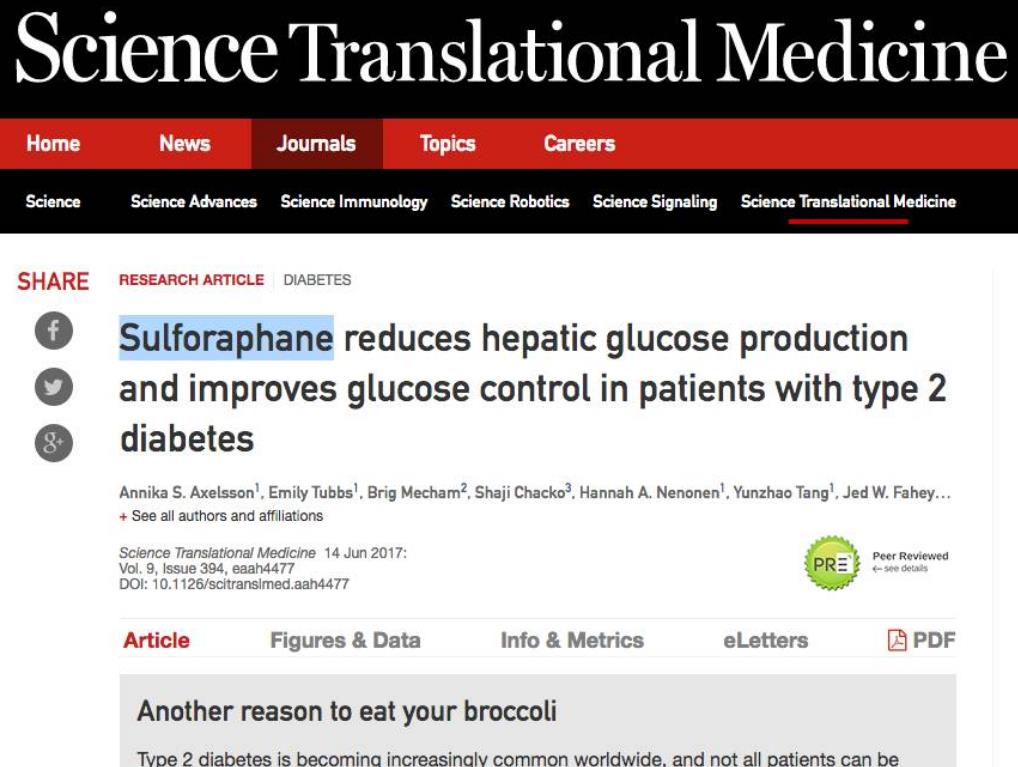
The Anders Rosengren research team of the University of Gothenburg in Sweden found that this effect is also reflected in the human body. The study was published in Science TranslationalMedicine on the 14th. 

 In this new study, the researchers analyzed the gene expression patterns associated with type 2 diabetes and compared them with the gene markers of thousands of candidate drugs to find compounds related to gene expression specificity in hepatocytes. The researchers finally found radish sulfide from these compounds, a common natural compound in cruciferous vegetables such as broccoli, which has a strong effect on diabetes-related gene expression. The researchers then cultivated hepatocytes from type 2 diabetic rats and treated them with radish thiolin. It was found that radish thiocin can inhibit glucose production in culture cells and improve glucose tolerance in high-fat or high-sugar diet mice. In view of the optimistic results of cell and animal experiments, the researchers then conducted clinical trials. 

 The study recruited 97 patients with type II diabetes to take high concentrations of radish thiodin or placebo every day for three months. Three of the subjects did not take metformin, and the others continued to take it during the trial. Three subjects were able to control blood sugar levels without metformin. Compared with the placebo control group, the blood sugar of those who took radish thionin decreased by an average of 10%. Diabetic obese patients with "abnormal regulation" have the largest drop in blood glucose levels, and their baseline blood glucose concentration.

10% doesn't sound like that much, but it's enough to reduce the risk of complications in the eyes and kidneys. The concentration of radish sulfurin is about 100 times that of broccoli. Rosengren said, "It is equivalent to eating 5 kilograms of broccoli every day." Therefore, it seems difficult to achieve such an effect by eating broccoli. 

 The study also found that the way of sulfine radish to lower blood sugar is completely different from that of metformin. Metformin makes cells more sensitive to insulin response, allowing cells to consume too much sugar in the blood. Radish sulfide reduces the release of glucose from the liver to the blood by inhibiting the enzyme activity of the liver that drives glucose production. This suggests that radish sulfine and metformin can be used in combination. The research team is working with the Swedish Farmers' Association to seek approval of bronland pollen as a drug. 

 Radisulfide is a classic compound. Its main biological function is to activate a transcription factor Nrf2 in the cell. Nrf2 is the common transcription factor of two-phase detoxification enzyme and antioxidant enzyme. It is the most important regulator that regulates the expression of a variety of antioxidant synthase and antioxidant enzyme gene, and maintains the oxidox balance of cells. It is also an important regulator of the inflammatory balance in the body. Sulfurine is the strongest natural activator, so a large number of studies have found that this natural substance has the ability to improve the body's own antioxidant and anti-inflammatory ability, and is a key factor in the fight against cancer in many foods such as broccoli.


Leave Your Message


Leave a message

We use cookie to improve your online experience. By continuing to browse this website, you agree to our use of cookie.

Cookies

Please read our Terms and Conditions and this Policy before accessing or using our Services. If you cannot agree with this Policy or the Terms and Conditions, please do not access or use our Services. If you are located in a jurisdiction outside the European Economic Area, by using our Services, you accept the Terms and Conditions and accept our privacy practices described in this Policy.
We may modify this Policy at any time, without prior notice, and changes may apply to any Personal Information we already hold about you, as well as any new Personal Information collected after the Policy is modified. If we make changes, we will notify you by revising the date at the top of this Policy. We will provide you with advanced notice if we make any material changes to how we collect, use or disclose your Personal Information that impact your rights under this Policy. If you are located in a jurisdiction other than the European Economic Area, the United Kingdom or Switzerland (collectively “European Countries”), your continued access or use of our Services after receiving the notice of changes, constitutes your acknowledgement that you accept the updated Policy. In addition, we may provide you with real time disclosures or additional information about the Personal Information handling practices of specific parts of our Services. Such notices may supplement this Policy or provide you with additional choices about how we process your Personal Information.


Cookies

Cookies are small text files stored on your device when you access most Websites on the internet or open certain emails. Among other things, Cookies allow a Website to recognize your device and remember if you've been to the Website before. Examples of information collected by Cookies include your browser type and the address of the Website from which you arrived at our Website as well as IP address and clickstream behavior (that is the pages you view and the links you click).We use the term cookie to refer to Cookies and technologies that perform a similar function to Cookies (e.g., tags, pixels, web beacons, etc.). Cookies can be read by the originating Website on each subsequent visit and by any other Website that recognizes the cookie. The Website uses Cookies in order to make the Website easier to use, to support a better user experience, including the provision of information and functionality to you, as well as to provide us with information about how the Website is used so that we can make sure it is as up to date, relevant, and error free as we can. Cookies on the Website We use Cookies to personalize your experience when you visit the Site, uniquely identify your computer for security purposes, and enable us and our third-party service providers to serve ads on our behalf across the internet.

We classify Cookies in the following categories:
 ●  Strictly Necessary Cookies
 ●  Performance Cookies
 ●  Functional Cookies
 ●  Targeting Cookies


Cookie List
A cookie is a small piece of data (text file) that a website – when visited by a user – asks your browser to store on your device in order to remember information about you, such as your language preference or login information. Those cookies are set by us and called first-party cookies. We also use third-party cookies – which are cookies from a domain different than the domain of the website you are visiting – for our advertising and marketing efforts. More specifically, we use cookies and other tracking technologies for the following purposes:

Strictly Necessary Cookies
These cookies are necessary for the website to function and cannot be switched off in our systems. They are usually only set in response to actions made by you which amount to a request for services, such as setting your privacy preferences, logging in or filling in forms. You can set your browser to block or alert you about these cookies, but some parts of the site will not then work. These cookies do not store any personally identifiable information.

Functional Cookies
These cookies enable the website to provide enhanced functionality and personalisation. They may be set by us or by third party providers whose services we have added to our pages. If you do not allow these cookies then some or all of these services may not function properly.

Performance Cookies
These cookies allow us to count visits and traffic sources so we can measure and improve the performance of our site. They help us to know which pages are the most and least popular and see how visitors move around the site. All information these cookies collect is aggregated and therefore anonymous. If you do not allow these cookies we will not know when you have visited our site, and will not be able to monitor its performance.

Targeting Cookies
These cookies may be set through our site by our advertising partners. They may be used by those companies to build a profile of your interests and show you relevant adverts on other sites. They do not store directly personal information, but are based on uniquely identifying your browser and internet device. If you do not allow these cookies, you will experience less targeted advertising.

How To Turn Off Cookies
You can choose to restrict or block Cookies through your browser settings at any time. Please note that certain Cookies may be set as soon as you visit the Website, but you can remove them using your browser settings. However, please be aware that restricting or blocking Cookies set on the Website may impact the functionality or performance of the Website or prevent you from using certain services provided through the Website. It will also affect our ability to update the Website to cater for user preferences and improve performance. Cookies within Mobile Applications

We only use Strictly Necessary Cookies on our mobile applications. These Cookies are critical to the functionality of our applications, so if you block or delete these Cookies you may not be able to use the application. These Cookies are not shared with any other application on your mobile device. We never use the Cookies from the mobile application to store personal information about you.

If you have questions or concerns regarding any information in this Privacy Policy, please contact us by email at . You can also contact us via our customer service at our Site.